
Science
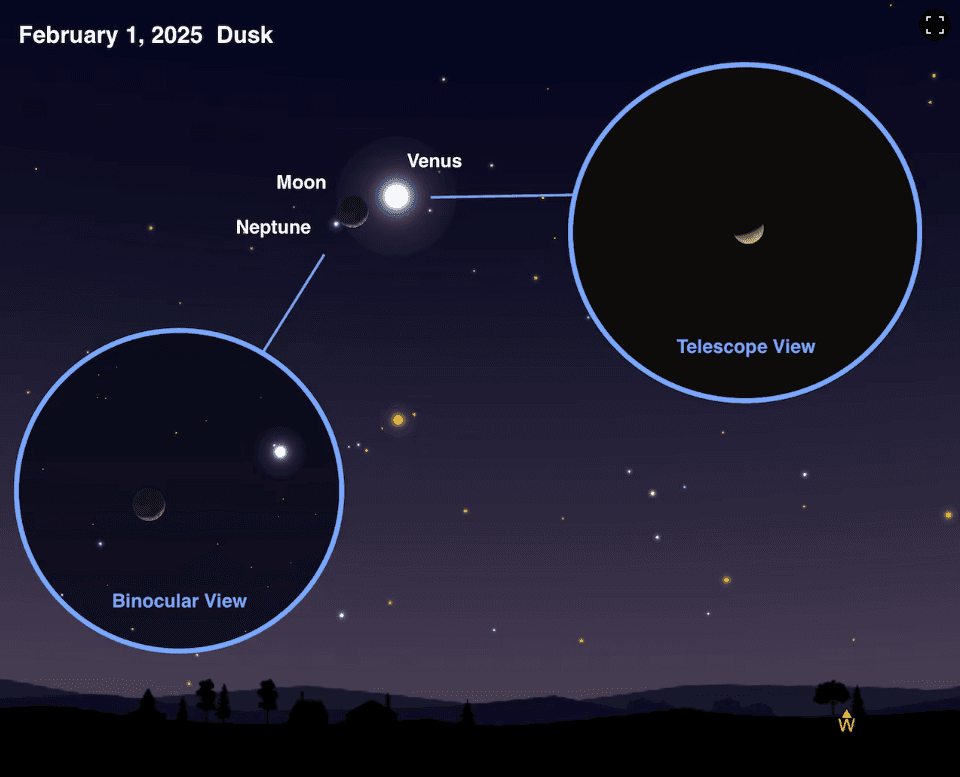
The night sky is set to dazzle skywatchers this February with a rare alignment of up to seven planets, including Mercury, Venus, Mars, Jupiter, Saturn, Uranus, and Neptune. This celestial event offers a unique opportunity to glimpse these planets in a single sweeping view, with the moon joining the cosmic festivities early in the month.
The Planetary Lineup
The alignment includes five planets that can be spotted with the naked eye: Mercury, Venus, Mars, Jupiter, and Saturn. Each of these planets is bright enough to be visible even under city lights, with Venus shining the brightest and Mercury being the faintest and most challenging to spot. For those with binoculars, Uranus and Neptune can also be observed, appearing as greenish-blue fuzzy points of light between Jupiter and Venus in the southwestern sky. A small telescope will reveal these ice giants as tiny disks.
Using the Moon as a Guide
The moon serves as a convenient guidepost, posing with a different planet each day. Key dates include:
January 31: The moon is closest to Saturn.
February 1: The moon huddles close to Venus and Neptune.
February 5: The moon points to Uranus.
February 6: The moon joins Jupiter, forming a visually impressive lineup with the bright orange-hued star Aldebaran.
February 9: The moon meets Mars, accompanied by the bright Gemini constellation stars, Castor and Pollux.
February 24: Mercury rises near Saturn.
How to Witness the Alignment
This celestial event is accessible to most of the world's population. To catch all seven planets, especially Mercury towards the end of February, find a clear view of the low southwestern horizon 30 to 45 minutes after sunset. The planets will begin to disperse by mid-March, so don't miss this opportunity to gaze into the vast expanse of our solar system.
The Cosmic Perspective
As you look up at these planets, remember that they are spread across millions of miles, from Mercury's 36 million miles to Neptune's 2.8 billion miles from the Sun. Yet, for a brief moment, they align in our sky, offering a breathtaking view of celestial harmony.
Source:
Andrew Fazekas, National Geographic https://www.nationalgeographic.com/science/article/planet-visible-alignment-february
Image Credit: Illustration by Andrew Fazekas